Doug Macdonald
  • My Services
    • Enterprise Strategy
    • Payments Strategy
    • Digital Transformation
    • Regulatory Support
    • Board Governance
  • Speaking/Media
  • Bio
  • Insights

Insights


January 2025
  •  The credit union digital banking race: key players and what comes next

November 2024​
  •  What’s going on in credit union technology delivery?
April 2024​
  • High interest rates and inflation have hit credit unions hard, but not equally
March 2024
  • This study of online banking shows Canadas' credit unions and challengers have work to do
Jan 2024
  • ​​Desjardins is rationalizing its branch network. Can (or should) banks and credit unions follow?
Dec 2023
  • Higher rates have not brought higher net interest margins
Nov 2023
  • Do credit unions really need five companies to manage $18B of statutory liquidity?
  • The PSCU-Co-op mega-merger: Three (hard) lessons for Canadian credit unions
  • ​For Saskatchewan's credit unions, what comes after Concentra?
Oct 2023
  • Credit unions are getting leaner - and need to keep going
  • Here are Canada's credit union growth leaders
  • Introducing CUGAR: Recognizing credit unions built for growth

Sep 2023​
  • Credit unions can (and must) win in the GTA... but are they ready?
  • Credit unions are bleeding deposit share everywhere... except Ontario
​Aug 2023
  • Credit Unions are losing the war for domestic deposits

Credit unions are getting leaner - and need to keep going

24/10/2023

 
Note: Saskatchewan credit unions received major one-time dividends in 2022 due to the sale of Concentra Bank. In some cases this improved profitability by 200% or more. Unless otherwise indicated the data below has not backed this out.

The good news is, Canada’s credit unions are getting more efficient. Even better, they are improving by growing revenue faster than expenses. This means their operating assets are becoming more productive. The challenge is that most still lag materially behind their big and small bank competitors. And, 1/3 of CUs are moving in the wrong direction. Working both individually and collectively to embrace efficiency will be critical for sustained credit union competitiveness.

From 2019-2022 credit unions over $500M in assets improved their efficiency from 74.4 to 70.8, and in doing so removed almost $300M in annual costs.
Picture

What's an efficiency ratio?

​In banking, an efficiency ratio is calculated by dividing operating expenses over operating income. Operating expenses are all non-interest costs (e.g., salaries, technology, rent). Operating income consists of net interest margin (interest revenue less interest expenses) plus non-interest revenue. An organization with $100M in revenue and $80M in expenses would have an efficiency ratio of 80, and an operating margin of 20%.

What's a good number?

The more efficient you are as an organization, the lower your efficiency ratio. Efficient operations allow a financial institution to grow capital, pay out dividends and invest in future growth. The higher your efficiency ratio the less able you are to continue as a going concern. Sustained efficiencies over 90 represent a major risk. Big banks typically range from 45-50 for Canadian Personal & Commercial operations and 50-55 overall, while niche FIs can go as low as the 30s or even 20s.

Efficiency ratios will naturally fluctuate over time. Significant uncapitalized technology spend, for example, can drive up the ratio in the short term in exchange for longer-term benefits. Merging in a less efficient peer can increase the ratio until economies of scale are realized. It's also possible to run too lean. Failure to invest for the future can have serious long-term consequences.

​Efficiency is particularly important for credit unions, who must rely on retained earnings as their primary source of regulatory capital. Credit unions who can grow top-line revenue faster than costs will see a continuous improvement to their efficiency ratios.

​How are credit unions performing?

For credit unions over $500M in assets, the weighted average efficiency in 2022 was 70.8. This is a material improvement over 2019’s 74.4. Note that this is generally due to scale benefits vs. structural cost reductions. In the three-year period revenue increased by 7.6% annually, while costs only increased by 5.9%. As a result, credit unions now spend an estimated $297M a year less than they would have if their efficiencies stayed unchanged!

For credit unions >$500M, 67% (44 of 66) saw their efficiency positions improve between 2019 and 2022. Conversely, 22 saw their efficiency ratios grow.

​Amongst large credit unions there are a few standouts:

Prospera
Went from 101.0 pre-merger with Westminster Savings down to 79.4, for an efficiency gain of 21.6 (Westminster Savings was at 80.5). In three years the combined organization was able to execute the single largest merger in credit union history and remove millions of dollars in overhead. The new Prospera has grown revenue by 12% vs the two legacy organizations, while costs are down by 1%. This demonstrates the power of economies of scale.

Conexus
Conexus is a good example of organic efficiency gains. From 2019-2022 expenses grew from $151M to $159M, while revenues increase from $202M to $278M. Conexus' efficiency ratio dropped from 74.9 to 57.2 without significant cuts. Rather, their operating assets became significantly more productive.

Meridian
​In the mid- to late-2010s Meridian launched an aggressive growth program. Meridian aquired Roynat Lease Finance, launched Motusbank and expanded their retail footprint in Toronto and the GTA. This resulted in higher operating costs and a 72.9 efficiency ratio. In the three years following Meridian has grown revenues by a third while only increasing costs by 15%. The resulting 61.4 efficiency for Canada's second-largest credit union is a gain of 11.4. Meridian now spends $120M less than Vancity to generate roughly the same revenue (note, however, that Vancity has consciously adopted a very different growth and service strategy).

Smaller credit unions also exhibited significant gains:

Radius, Weyburn, Prairie Centre and Diamond North
All four credit unions saw their efficiencies improve by over 20 due to growing revenue while holding down operating cost increases. Radius organically grew revenue by 67% while costs increased by just 7%. Diamond North merged in Debden credit union in 2019 and has gone on to more than double revenues while only increasing costs by 30%.

Westoba
Westoba realized the largest cost reduction in real dollar terms. Westoba was able to drop costs from $41M in 2019 to $33M in 2022, a reduction of almost $9M. This resulted in an efficiency gain from 88.4 to 70.0, putting the organization on a significantly stronger financial footing.

The efficiency imperative

What is the right number? That depends. A branchless digital bank or wholesaler should have a very low efficiency ratio. Conversely, a large community-focused organization that pays a living wage and rewards members with better rates will have a much higher ratio. Scale also plays an important role - it's much easier to run lean when you are very small or very large. Mid-sized financial institutions like Canada's largest credit unions will be caught in the middle. Should all credit unions be lower than the big banks? Probably not. But many are still sitting at unsustainable levels.

Efficient operations are a pre-requisite for sustained growth. Credit unions should explore efficiencies at both the individual and collective level. In particular, they should seek collective solutions to new business problems and opportunities so that the same costs aren't repeated 200 times.

Here are Canada's credit union growth leaders

15/10/2023


Which credit unions are built for growth?

Note: Saskatchewan credit unions received major one-time dividends in 2022 due to the sale of Concentra Bank. In some cases this improved profitability by 200% or more. Unless otherwise noted the data below has not backed this out.

​In the previous Insight I introduced the concept of the Credit Union Growth Alignment Rating, or CUGAR. The CUGAR rates a credit union's historic growth performance, revenue resiliance and internal capacity to grow using publicly-available information. The purpose of the CUGAR is to identify market leaders, help to understand how each credit union takes a unique approach to growth, and provides guidance on where credit unions can look to improve their growth postures.

The score is nominally out of 10, though no financial institution should expect to get a "perfect" rating. The scale is calibrated so big banks land in the 5-6 range. For more details on how the CUGAR is calculated, see the previous post.

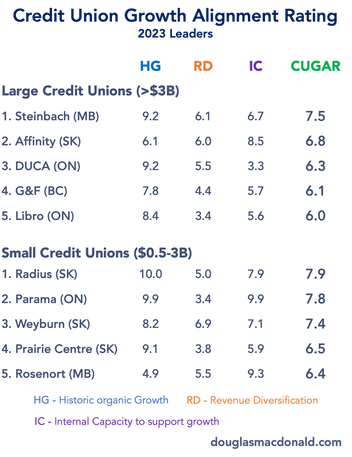
So who are the leaders, and what can they teach us about successful growth strategies? Here are the top five large and small credit unions based on 2022 annual reports:
Picture

Large credit union leaders

Canada's top-rating large credit unions all exhibited strong asset and revenue growth over the past three years, though they each take a slightly different approach to their growth strategies.

Scoring highest is Steinbach, with an extremely efficient operation and strong assets per member driving significant growth. Steinbach's business is heavily biased towards net interest income, reflecting its position as a lending market leader in Manitoba. Steinbach's capital ratio is lower than its peers, in part due to a generous patronage program.

In the #2 position is Affinity, which scores well based on good all-round rating and the potential for future growth. Affinity has a highly-diversified revenue stream, runs lean and is very well capitalized. These are strong building blocks that can enable an effective growth strategy.

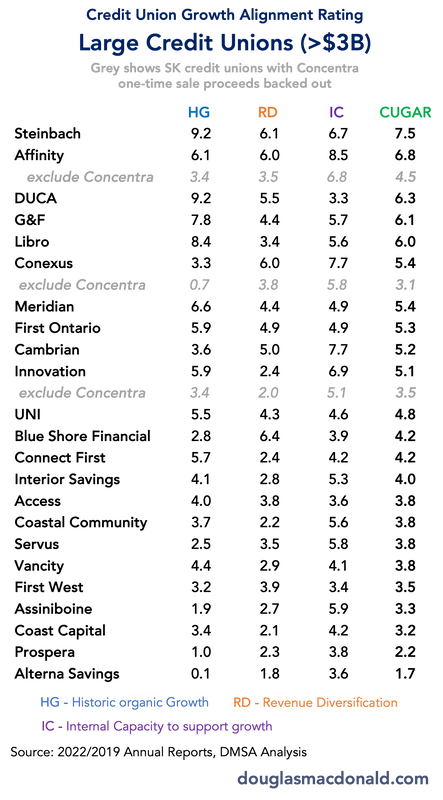
DUCA, G&F and Libro have all exhibited strong asset growth. A focus on efficiency and revenue diversification will help translate these gains into stronger revenue, but overall these credit unions are performing above their large bank peers.
Picture

Small credit union leaders

At the top of the small credit union list are five niche credit unions who are laser-focused on delivering a subset of financial services products to specific communities of members. This generally means very efficient operations, limited diversification and strong organic growth.

As the top-ranked credit union, Radius is in full organic growth mode. Based in Southern Saskatchewan, Radius serves specific rural communities with an agricultural business focus. This has resulted in very high assets per member. Combined with very efficient operations and a strong service culture, Radius has grown assets and revenue at a rapid pace.

Parama tells a similar story, though in this case they serve Toronto's Lithuanian community. Prairie Centre and Rosenort follow the same rural niche model as Radius.

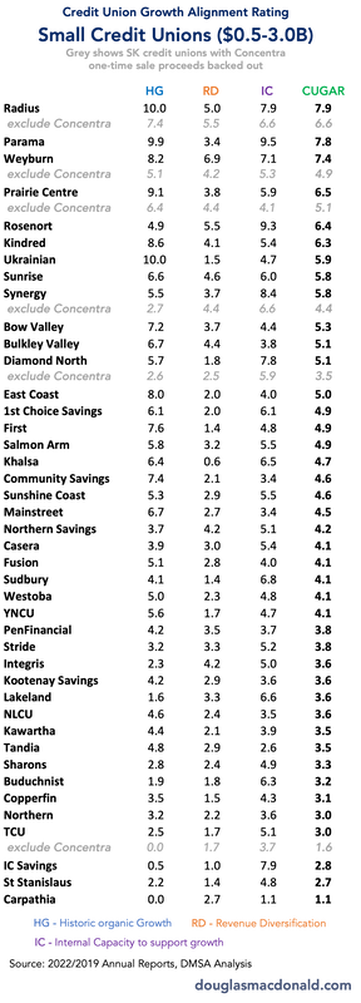
Weyburn follows a different path, with more revenue diversity but lower assets per member. They have been rewarded with strong revenue growth over the past three years.
Picture

The full list

Shown below are credit unions with greater than $500M in assets and for which there is readily-available financial information. I have tried to back out most of the merger growth, though some still remains (this will artificially inflate the Historic Growth rating).

As I mentioned in the previous Insight, it is important not to look at the CUGAR in isolation. Credit unions compete in different markets, with different financial realities. Credit unions riding the mortgage growth wave in Toronto and Vancouver will be very different from rural Nova Scotia. However, it can be useful to look at peers to see what lessons can be learned from each other. Credit unions can also track their results over time to see if they are trending in the right direction.
Picture
Picture

Feedback

This is my first attempt at quantifying credit union growth postures. I've certainly learned a lot in this exercise, and I know it can do more.

How do you think it could be improved? Should it, for example, assess the difference between commercial and retail members? Are the scoring ranges too aggressive or too lenient? What else would you want to see included in the calculation?

I'm always interested to receive feedback on my analysis via email or on my LinkedIn page.

Introducing CUGAR: Recognizing credit unions built for growth
11/10/2023


Which credit unions are growth leaders?

I’ve spent a lot of time lately thinking about how to help credit unions and challenger banks grow and stay competitive. This has led me to ask a critical question - which credit unions are best at delivering an effective growth strategy?

This is my first cut at answering the question using publicly-available financial data. And, I’ll be the first to admit, some the results surprised me!

Introducing CUGAR

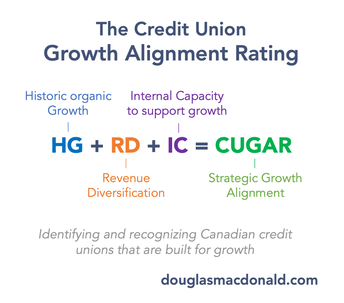
Introducing the Credit Union Growth Alignment Rating. The CUGAR estimates a CU’s readiness to grow across three categories:
  • Track record of organic (non-merger) asset and revenue growth
  • Diversity of revenue streams
  • Financial capacity to fund growth
Picture

Designing the CUGAR

How can historical and publicly-available data be used to predict future growth? The CUGAR assesses six metrics grouped into three axes. Each axes receives a score between 0 and 10, which then combine into an overall CUGAR out of 10.

The three axes are:

1. Historical Organic Growth (Heavy weighting)
The best predictor of future performance is recent performance. In this case we look at two factors: organic (non-merger) asset growth and organic revenue growth. This is calculated via CAGR from the previous three fiscal years (2019-2022) with merger growth removed. Financial institutions where asset growth exceeds 10% and revenue growth exceeds 20% receive a full 10.

2. Revenue Diversity (Medium weighting)
Credit unions with a range of revenue sources are more resilient and provide more opportunities to deepen member relationships. Revenue diversity can be achieved in a number of ways. Examples include mortgage vs unsecured lending, personal vs business members and interest vs non-interest revenue. Depth of a member relationship is also important. It’s easier to sell a third or fourth product to a member vs. going from one to two.

It’s difficult to go in and assess every credit union’s product mix, so in this case we look two indicators: 1) the share of operating revenue coming from non-interest sources and 2) assets per member. To receive the full 10 points, credit unions must generate >50% of revenue from non-interest income, and have assets per member >$100k.

3. Internal Capacity to Grow (Medium weighting)
If you want to grow, you need a way to fund and deliver it. That means efficient operations and strong capitalization. Credit unions receive a 10 score in this axes when efficiency ratio is <50% and total risk-weighted capital ratio exceeds 18%.

Scale check

How do non-credit union FIs rank on the CUGAR scale? A fair measuring system would anchor the big banks at around the middle of the range, with room for smaller competitors to place higher or lower.

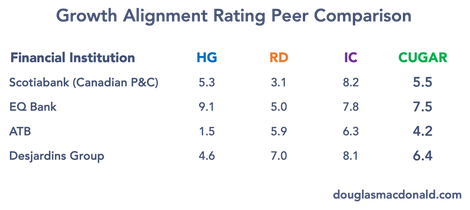
This holds up when the formula is applied to three bank competitors and a cooperative peer. Scotiabank’s Canadian Personal & Commercial business - a very large and mature operation that is by all measures a successful business - scores a 5.5. EQ bank, a nimble challenger, rates higher with 7.5. ATB rates 4.2 while Desjardins comes in at a strong 6.4. 
Picture
Note that, as expected, each FI has different areas of relative strength based on their specific strategy. Scotia and Desjardins are a well-rounded competitors, while EQ excells in a limited range of products:​
Picture
When applied to credit unions, large (>$3B) CUs with publicly-available data range from 7.5 to 1.7, with an average of 4.6. Meanwhile, small CUs in $500M-$3B asset range come in between 7.9 to 1.1, with an average of 4.5.

Usage and Limitations

How is CUGAR useful? It can be used to identify market leaders, and provide some initial guidance on why they are successful. For example, a niche CU with high growth and low diversification can be a solid strategy, assuming they truly are best in class at serving a specific set of products to their community. Meanwhile, a large institution with a wide range of products and strong balance sheet can find success delivering an excellent full-service experience.

CUGAR is one tool credit unions can use to compare themselves against peers and competitors, and see where there are opportunities to strengthen their growth capabilities. Credit unions can also track their results over time to see if they are trending in the right direction.

​I haven’t run a regression on historical data to see how predictive this score is. I would also caution readers to directly compare credit union scores against each other without considering the whole picture. A niche credit union in downtown Winnipeg will have a very different market, cost structure and growth path vs. a regional Atlantic counterpart.

Who are the CUGAR leaders? We'll cover that in the next Insight.

    Doug Macdonald

    Analysis of credit union, challenger bank and fintech competitiveness.

    All opinions are my own and not attributable to clients, employers or other parties.

    Archives

    January 2025
    November 2024
    April 2024
    March 2024
    January 2024
    December 2023
    November 2023
    October 2023
    September 2023
    August 2023

    Categories

    All

    RSS Feed

©️ Doug Macdonald Strategic Advisory Ltd.
  • My Services
    • Enterprise Strategy
    • Payments Strategy
    • Digital Transformation
    • Regulatory Support
    • Board Governance
  • Speaking/Media
  • Bio
  • Insights