Doug Macdonald
  • My Services
    • Enterprise Strategy
    • Payments Strategy
    • Digital Transformation
    • Regulatory Support
    • Board Governance
  • Speaking/Media
  • Bio
  • Insights
  • Beyond the Big Six

Insights


January 2025
  •  The credit union digital banking race: key players and what comes next

November 2024​
  •  What’s going on in credit union technology delivery?
April 2024​
  • High interest rates and inflation have hit credit unions hard, but not equally
March 2024
  • This study of online banking shows Canadas' credit unions and challengers have work to do
Jan 2024
  • ​​Desjardins is rationalizing its branch network. Can (or should) banks and credit unions follow?
Dec 2023
  • Higher rates have not brought higher net interest margins
Nov 2023
  • Do credit unions really need five companies to manage $18B of statutory liquidity?
  • The PSCU-Co-op mega-merger: Three (hard) lessons for Canadian credit unions
  • ​For Saskatchewan's credit unions, what comes after Concentra?
Oct 2023
  • Credit unions are getting leaner - and need to keep going
  • Here are Canada's credit union growth leaders
  • Introducing CUGAR: Recognizing credit unions built for growth
Sep 2023​
  • Credit unions can (and must) win in the GTA... but are they ready?
  • Credit unions are bleeding deposit share everywhere... except Ontario
​Aug 2023
  • Credit Unions are losing the war for domestic deposits

Do credit unions really need five companies to manage $18B of statutory liquidity?

29/11/2023

 
Investing statutory liquidity is a relatively straightforward business to manage. The benefits of scale and centralized expertise are clear. Yet credit unions currently split this business across five different companies. Why?

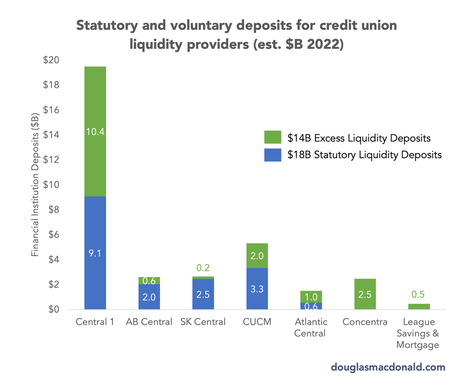
Canada's five credit union centrals manage about $18B of statutory liquidity on behalf of their member credit unions. Of this, almost half is administered by Central 1, the central for Ontario and BC. A further $14B or so of non-statutory deposits are also managed by the centrals and another $3B at two other shared liquidity providers.

Central 1 spent $39.3M to run their treasury group in 2022 (this includes both statutory and excess liquidity totalling approx. $20B). Duplicate treasury services exist in the other four centrals, plus at Concentra Bank and League Savings & Mortgage. Add in the cost of individual credit unions managing their own funds and the total cost of CU liquidity administration is in the hundreds of millions of dollars.

In contrast, Alberta's public sector pension spent a mere $14M to manage their $17B investment fund. Treasury and pensions are not directly comparable, but the cost difference is pronounced.

How can credit unions achieve liquidity management scale without merging the centrals? Read more here: 

What is statutory and excess liquidity?

Statutory liquidity
All deposit-taking financial institutions must keep a portion of their assets in reserve to withstand a run of withdrawals. Known as "high quality liquid assets", or HQLA, these assets can be "easily and immediately converted into cash at little or no loss of value" (ref). Examples include deposits at the Bank of Canada, demand deposits at other financial institutions, government bonds, quality corporate debt and similar instruments.

Most provincially-regulated credit unions are by law required to deposit their statutory liquidity in their provincial central, who then invests it in HQLA on their behalf. If a credit union experiences a liquidity crisis the central acts like a mini Bank of Canada and provides emergency cash. By pooling their resources, credit unions achieve better rates and can support each other in times of need. Deposit requirements vary by province but are in the range of 6-10% of each credit union's financial assets. In 2022, statutory deposits at the five centrals totaled approximately $18B.

Excess liquidity
Credit unions with more cash than needed can use their own treasury department or rely on an intermediary. Excess Liquidity does not have the same strict requirements as HQLA and can generate higher returns. Collaboration is especially import for smaller credit unions that lack the expertise and/or scale to achieve better pricing. Key providers of excess liquidity services are the centrals, Concentra Bank (now owned by EQ) and League Savings & Mortgage (owned by the Atlantic credit unions).

Excess liquidity at the centrals, Concentra and LSM totaled approx. $17B in 2022. A number of credit unions, particularly the largest, manage their own excess liquidity rather than go through an aggregator.
Picture
Note: Central annual reports do not consistently report statutory vs excess liquidity, so the above chart is a best estimate. Central 1's statutory liquidity is held off-book in a protected fund and managed by C1 via a cost-recovery contract. 

Reducing costs and improving returns

Merging the centrals is one method of achieving scale. Combining Ontario and BC into Central 1 and NB/NS/PE/NL into Atlantic Central was done in part to improve the efficiency and effectiveness of their treasury departments. Various other combinations have been considered, but not pursued. At this point further mergers are not necessary, nor particularly desireable. Mergers create complex governance models, require compliance with multiple regulatory regimes and distract from running credit union businesses.

However, the centrals are not prevented from handing over management of liquidity to a shared service. Indeed, this is already the case in Central 1 and the Atlantic, where individual provincial funds are managed by the parent company. A single treasury group could be built from the best of the provincial Centrals by creating joint venture or similar structure. Liquidity funds could even be administered by a third party, contracted out much like how a pension fund or endowment hires money managers. Funds remain on the books of the provincial Centrals and subject to all the usual oversight.

While there are provincial differences, HQLA is HQLA. By definition it is a low risk business. Provincial centrals are all investing in the same vehicles. There is no compelling strategic reason to manage them separately.

A $32B pool is respectable by Canadian standards. That's half the holdings of the OMERS pension fund, and about 10% of the $308B in financial institution deposits held by Canadian banks. If individual credit unions pooled their self-managed liquidity the fund would be even larger. Even with the complexity of managing segregated pools and multiple regulations this is an attractive business for a third-party money manager or credit union joint venture.

Managing change
This action would of course be controversial. Centrals are (rightfully) proud of their role in strengthening their provincial systems, and of their in-house expertise. And treasury alone won't solve the problem of reducing system costs. But there is no strategic benefit to running five different treasury services because of a collaboration model designed in the 1970s.

If credit unions want to become more efficient and effective, combining statutory and excess liquidity management is an excellent place to start.

Let's chat!
Want to discuss this topic in greater detail? Start the conversation by reaching out to me via email or on LinkedIn.

The PSCU-Co-op mega-merger: Three (hard) lessons for Canadian credit unions

16/11/2023

 
Canadian credit unions can be forgiven for missing last week’s merger announcement between US shared services giants PSCU and Co-op Solutions. These organizations work largely behind the scenes, delivering strategic payments and digital capabilities for American credit unions.

Combining the payments, digital and operations expertise of these providers will deliver critical scale and expertise to their member organizations, reduce duplication and improve strategic flexibility. The combined organization will process 16 billion transactions annually and serve over 100 million members across more than 4,000 credit unions.

I’ve met with both organizations’ leadership, toured their operations centres and worked with their teams on a day-to-day basis. I am confident that this deal will deliver a robust and flexible payments and technology platform that will keep America’s credit unions competitive will into the next decade.

Unfortunately, this unification trend stands in contrast to Canadian shared services. Rather than trending towards combining forces, Canada's credit union system continues to experience fragmentation. In this week’s Insight I highlight three hard (and perhaps controversial) lessons from the merger for the Canadian ecosystem.

  1. Payments need scale
  2. In-house systems are strategic anchors
  3. Collaboration requires collaboration
Picture

(Hard) Lesson 1: Payments Need Scale

PSCU and Co-op provide credit, debit and wholesale payments services to most American credit unions and numerous community banks. Co-op also provides the back end and digital credit card platform for Collabria, used by most of Canada’s credit unions, and holds a majority ownership stake in Everlink.

However, America's credit unions have concluded that each entity's 8+ billion annual transactions do not provide enough scale. The combined company will process an astonishing 30,000 transactions every minute and be one of Fiserv’s largest global payments customers. This will result in preferential pricing and support for all credit unions, allowing them to compete against the big banks. Co-op also operates a 30,000-strong ATM network with common branding, shared deposits and no fees.

Take-aways for Canada:
  • Core Payments: Canadian credit unions currently split their 6-8% payments market share across two different providers. This was an interesting experiment that didn’t work out. Costs are high, expertise is diluted and the rest of the payments industry is nervous about credit union connectivity. Credit unions need to combine Central 1 and PPJVs operations, write off sunk costs and move forward together.
  • Credit Cards: Three credit unions self-issue, one uses a fintech and the other 98% partner with Collabria. Again, costs are duplicated and expertise is diluted. Combining these portfolios would approach the one million account threshold needed for a credit portfolio to operate at full scale.
  • Debit Cards: Credit Unions need to ensure that Everlink will continue to serve as a stable and effective debit partner
  • ATMs: Canadian CUs should combine their networks to achieve economies of scale and serve as a critical marketing platform
  • Real-Time-Rail: Combining development efforts will likely be far more effective than individual credit unions seeking direct access to the RTR

(Hard) Lesson 2: In-house systems are strategic anchors

The combined entity will offer full-service digital and payments capabilities for thousands of credit unions. By using "off the shelf" solutions, credit unions of all sizes have access to capabilities not present in Canada, including:
​
  • 24/7 US-based contact centres offering full banking services to credit union members
  • Shared branching (Co-op currently provides this for 62M members across 1,800 CUs)
  • Combined payments and digital banking apps
  • API integration with core banking, LOS, CRM and other services
  • Centralized fraud and risk management
  • Fully managed digital environments

PSCU and Co-op also serve as integration points for strategic partners. For example, when credit unions asked for improved mobile capabilities, Co-op partnered with app developer OnDot and took on responsibility for development and integration. This freed up credit unions to focus on their core activities.

Take-aways for Canada:
  • It's currently too hard for strategic partners to sell to, develop for and integrate with the Canadian credit union system. Partners want to work with credit unions, but not via 200 relationships
  • Central 1's Forge, Celero's XPress and League Data's Mambu have the potential to serve as third-party accelerators, but only if business, legal and technology capabilities are developed together
  • Canadian CUs operate too many core banking systems, consuming scarce resources and exposing members to unnecessary risk for limited strategic gain. By 2030 all credit unions should be running on fully outsourced cores
  • Digital innovation does not replace business fundamentals. Canada's large banks are growing quickly despite a hodgepodge of digital capabilities, while digital-first challenger banks are struggling to capture market share. Outsourcing digital roadmaps allows credit unions to realize scale while focusing on their core competencies of sales and service 

(Hard) Lesson 3: Collaboration requires collaboration

PSCU and Co-op have been successful in part due to how they work with credit union and bank clients. Co-op Solutions jointly develops its technology roadmap with credit unions via the use of Co-creation Councils and other feedback loops. PSCU runs an annual client survey and regularly gathers feedback from members. Both organizations also have Boards comprised of member credit union CEOs to ensure alignment with CU needs.

By keeping their clients close, PSCU and Co-op are able to build trust and buy-in. This both allows them to execute ambitious change programs and set the stage for successful merger discussions.

Take-aways for Canada:
  • Canada's shared service organizations need to evolve how they engage with credit unions to collaboratively set strategic priorities and execute complex programs
  • Shared services organizations must also develop service and pricing models that combine mandatory functions plus optional services based on client size and complexity.
  • Canada's credit unions need to take a more active ownership of shared initiatives, at both the governance and execution levels
  • American credit unions were able to negotiate the merger of two profitable multi-billion dollar organizations with competitive services and thousands of clients. They did it via building trust and planning for the future. There's no reason why Canada's credit unions can't do the same

​Have feedback, or would like to discuss how Canada's shared service providers need to evolve? Contact me on LinkedIn or via email.

For Saskatchewan's credit unions, what comes after Concentra?

7/11/2023

 
In 2022 Saskatchewan's credit unions received a huge one-time windfall from the sale of Concentra Bank. Credit unions have used their share of the revenue to strengthen their capital positions, invest in technology and return profits to members.

However, by converting a strategic asset into cash, the provincial system has moved away from shared delivery, lost a source of recurring revenue and handed control of their wholesale banking operations to a publicly-traded for-profit entity.  

Will Saskatchewan's credit unions leverage this opportunity to transform their businesses, or will this be a one-time event?

Some background

Concentra dates back to 1967 from its founding as the Co-operative Trust Co. of Canada. In 2005 it became Concentra Financial Services Association and in 2016 converted from a cooperative association to a Schedule I Bank. In 2022 Concentra Bank was sold to Equitable Bank, where it continues as a wholly-owned subsidiary.

Concentra was created as a shared service for Saskatchewan's credit unions to pool excess liquidity, offer Trust services, syndicate loans and other scale-dependent wholesale activities. As Concentra grew it expanded across borders to serve credit unions in other provinces, challenger banks and fintechs.

By 2022 Concentra had over $11B in on-book assets, $36B assets under management, $146M in revenue and profits of $43M. Concentra was 84% owned by Saskatchewan's credit unions via SaskCentral, the provincial liquidity provider.

Sale to Equitable Bank

In early 2022, Concentra announced an agreement to be acquired by Equitable Bank for approximately $470M, a $35M premium on book value. Concentra's sale was precipitated by a number of factors including Saskatchewan credit unions looking to simplify their shared services model, and by the provincial regulator's concerns over concentration risk. The deal closed in November 2022. Concentra Bank now operates as a subsidiary of EQ and day-to-day business has continued essentially unchanged. 

Impact on Saskatchewan's credit unions

Financial Impact
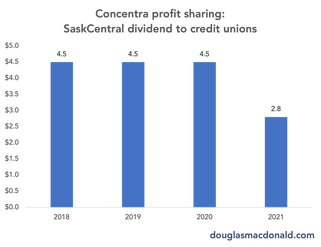
Concentra's sale created a huge one-time windfall for Saskatchewan's credit unions. SaskCentral normally distributed up to $5M in Concentra profits as dividends to member credit unions. 
Picture
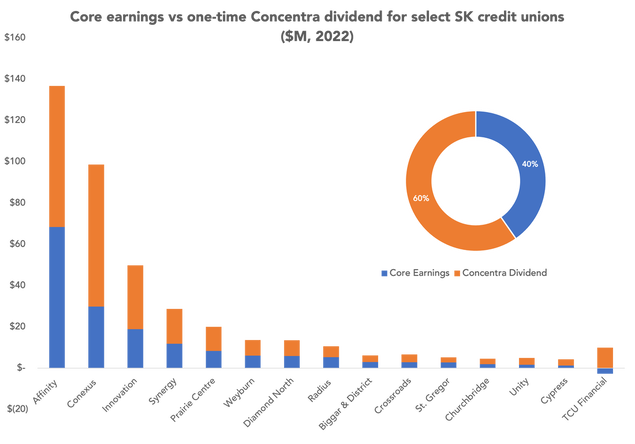
In 2022 that grew to a one-time payout of $290M. This represented approximately 25% of total Saskatchewan CU revenue and 60% of net income. Individual credit unions received up to $68M.
Picture
At first look it's hard to argue with the logic. Credit unions received 60 years worth of regular dividends in one go, generating a huge cash infusion and short-term profitability bump.  

Credit unions varied in their approach to dealing with this windfall. Unity credit union is a good example of an organization that divided the amount into different purpose-led buckets:
We utilized a portion of these funds to increase our Member Rewards allocation for 2022, pay the costs related to the Xpress banking implementation and make two donations of $50,000 each to the Hospital Auxiliary for the purchase of new beds and the Town of Unity to enhance the walking paths. The rest of the funds were used to build capital to strengthen the credit union’s financial position into the future. Since this was a one-time injection of funds, we tried to use them prudently.
​(Unity Credt Union 2022 Annual Report)

​
Other credit unions opted to split the funds between cash reserves and member patronage:
​From that sale Radius Credit Union received a tax-free dividend of just over $5.3 million that was then allocated to reserves. This one-time injection of capital has assisted with our capital growth and has enabled us to pay the almost $1.3 million in patronage payments to our membership.
(Radius Credit Union 2022 Annual Report)
The dividend also created a one-time boost to efficiency ratings and revenue diversification (depending on whether the CU booked the dividend as interest or non-interest revenue). The capital itself represented a boost of approximately 1% of each CU's total assets and will stay on the books. Any analysis of 2022 performance needs to take the dividend into account (note that I've updated my previous Insights to reflect this). 

Access to Wholesale Services
This cash payment came with a significant tradeoff in the form of lost control. Under their previous ownership model, credit union leaders sat on the Board of Concentra Bank. They exercised influence over everything from Concentra's pricing structure to technology investments. And they received a modest profit share. Now, Concentra is wholly-owned by a TSX-listed entity responsible for delivering profits to its major shareholders. 

Concentra Bank and EQ Inc have re-iterated their commitment to serving credit unions. New ownership may result in new products and services coming to market, leveraged by Equitable's increased scale and nimbleness. Should credit unions want to look elsewhere there are limited cooperative options. Central 1 and Desjardins both offer Trust services, and Desjardins is active in the treasury space. Big banks are generally uninterested in working with all but the very largest credit unions. Time will tell if this move will increase competitiveness in the wholesale banking marketplace.

Strategic Investments
The most significant impact will be if credit unions use this one-time cash injection to make themselves more competitive. This could include investments in digital platforms, strategic cost reductions or development of new products and services. Simply using the cash as a source of cheap regulatory capital is unlikely to make the kind of lasting change needed.

Looking ahead

Will Saskatchewan's credit unions revert back to normal performance, or will the Concentra sale be a trigger for sustained performance improvements? We'll get our first look when annual reports start coming out in early 2024.

Let's chat!
Want to discuss this topic in greater detail? Start the conversation by reaching out to me via email or on LinkedIn.

    Doug Macdonald

    Analysis of credit union, challenger bank and fintech competitiveness.

    All opinions are my own and not attributable to clients, employers or other parties.

    Archives

    January 2025
    November 2024
    April 2024
    March 2024
    January 2024
    December 2023
    November 2023
    October 2023
    September 2023
    August 2023

    Categories

    All

    RSS Feed

©️ Doug Macdonald Strategic Advisory Ltd.
  • My Services
    • Enterprise Strategy
    • Payments Strategy
    • Digital Transformation
    • Regulatory Support
    • Board Governance
  • Speaking/Media
  • Bio
  • Insights
  • Beyond the Big Six