Doug Macdonald
  • My Services
    • Enterprise Strategy
    • Payments Strategy
    • Digital Transformation
    • Regulatory Support
    • Board Governance
  • Speaking/Media
  • Bio
  • Insights

Insights


January 2025
  •  The credit union digital banking race: key players and what comes next

November 2024​
  •  What’s going on in credit union technology delivery?
April 2024​
  • High interest rates and inflation have hit credit unions hard, but not equally
March 2024
  • This study of online banking shows Canadas' credit unions and challengers have work to do
Jan 2024
  • ​​Desjardins is rationalizing its branch network. Can (or should) banks and credit unions follow?
Dec 2023
  • Higher rates have not brought higher net interest margins
Nov 2023
  • Do credit unions really need five companies to manage $18B of statutory liquidity?
  • The PSCU-Co-op mega-merger: Three (hard) lessons for Canadian credit unions
  • ​For Saskatchewan's credit unions, what comes after Concentra?
Oct 2023
  • Credit unions are getting leaner - and need to keep going
  • Here are Canada's credit union growth leaders
  • Introducing CUGAR: Recognizing credit unions built for growth
Sep 2023​
  • Credit unions can (and must) win in the GTA... but are they ready?
  • Credit unions are bleeding deposit share everywhere... except Ontario
​Aug 2023
  • Credit Unions are losing the war for domestic deposits

Higher rates have not brought higher net interest margins

19/12/2023

 
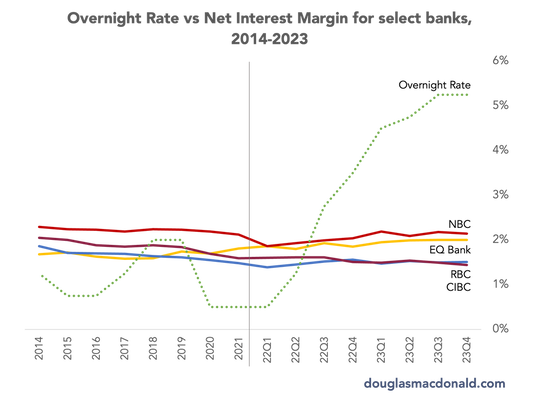
The 21st Century has seen two parallel financial trends - an extended period of low interest rates and net interest margin compression. Would margins return to historic levels once interest rates rose? After 18 months in an elevated interest rate environment, the answer appears to be a resounding no. 

Net interest margin, the difference between what a financial institution earns in interest vs what it pays, is a critical metric in fractional reserve banking. The larger the gap the more money you earn. Increased competition and other factors can cause the spread to shrink. One hypothesis is that as interest rates rise, so to will the spread. After all, an environment with 7% mortgages has more wiggle room than when they are at 2%.

However, data does not appear to be bearing this out. Of the five banks shown, four are reporting net interest margins lower than their average pre-inflation rates. Only EQ Bank has managed to increase its NIM in the last two years, continuing a trend that started back in 2018.

Will the situation change as more mortgages renew? What impact does this have on financial institution strategies?

​Read here for more: 
Picture

Life at the margins

Net interest margin has been on an extended decline. For example, RBC recorded a NIM of 2.97% in 1990. This dropped to 1.87% in 2000 and just 1.51% in Q4 of this year. RBC's NIM has trended down over this time, regardless of the Bank of Canada's rate decisions. CIBC has converged with RBC over the last decade, and all of the Big 5 are in essentially the same spot. at 1.5% margin, a bank will record just $15M of interest revenue on every $1B in their loan portfolio. 

Smaller financial institutions have a bit more leeway. National Bank and EQ Bank are both in the 2% range, while credit unions can vary widely depending on local market conditions and growth strategies.


We've now spent almost two years in a higher-rate environment. If financial institutions were hoping this would ease the pressure on net interest margin, that has not been the case. From 2014-2021 CIBC's average NIM was 1.85%, while today it is 1.44%. National bank went from 2.22% to 2.14%.

It is possible that duration will have an impact. EQ Bank tends to sell shorter-duration mortgages and more uninsured mortgages vs the big banks. Their margin has improved from 1.68% to 2.00%. As loans reset at the higher rates there is an opportunity to increase the spread. However, EQ's trend started back in 2017 - well before recent rate hikes.

Beyond NIM

NIM spreads can increase due to different product mixes (e.g., unsecured vs secured lending), capital strategies (e.g., relying on retained earnings vs. broker deposits vs. GICs) and other factors. These must of course be accompanied by appropriate risk management strategies.

Duration mismatch is another important factor. As Silicon Valley Bank showed, a long duration of lending mixed with short-term borrowing can prove fatal. Sound treasury management during a period of rate instability is critical. 

Financial institutions must also look to build resilience via revenue diversification. Developing sources of non-interest revenue is more important than ever.

Let's chat!
Want to discuss this topic in greater detail? Start the conversation by reaching out to me via email or on LinkedIn.

    Doug Macdonald

    Analysis of credit union, challenger bank and fintech competitiveness.

    All opinions are my own and not attributable to clients, employers or other parties.

    Archives

    January 2025
    November 2024
    April 2024
    March 2024
    January 2024
    December 2023
    November 2023
    October 2023
    September 2023
    August 2023

    Categories

    All

    RSS Feed

©️ Doug Macdonald Strategic Advisory Ltd.
  • My Services
    • Enterprise Strategy
    • Payments Strategy
    • Digital Transformation
    • Regulatory Support
    • Board Governance
  • Speaking/Media
  • Bio
  • Insights